
search
Transform legal compliance into measurable workplace impact with practical strategies for building genuinely inclusive organizations.
Equity, diversity and inclusion (EDI) have become central considerations for organisations across both the public and private sectors, extending beyond corporate values to encompass legal compliance, governance, and effective decision-making. While many organisations have established EDI policies, translating these commitments into legally robust practices remains a significant challenge. Employers, regulators, educational institutions, and policymakers must navigate equality legislation, human rights obligations, and evolving expectations around inclusive governance while managing legal and reputational risk.
This session examines the legal framework underpinning equity, diversity and inclusion and explores how organisations can move beyond policy statements to embed meaningful, lawful, and accountable practices. Participants will consider the interaction between equality law, governance, organisational decision-making, and emerging issues such as Indigenous inclusion, environmental justice, and institutional accountability, gaining practical insights into developing legally defensible and effective EDI strategies.
Key Topics Discussed:

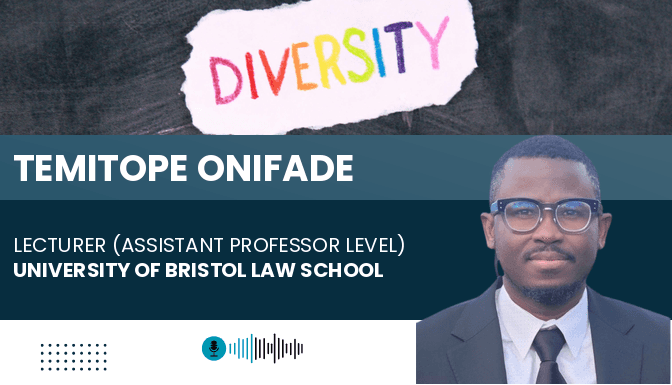
Lecturer (Assistant Professor level) | University of Bristol Law School
Temitope Onifade is a Lecturer at assistant professor level and a Co-Director of the Centre for Environmental Law and Sustainability at the University of Bristol Law School. He has also led as an academic chair of the Equality, Diversity and Inclusion Committee and a postgraduate programme director in that law school. Previously, Dr. Onifade worked as a consultant at Commonwealth Climate and Law Initiative at the University of Oxford, a co-founder and lead chair of the Liu Institute Network for Africa and an affiliated research scholar of the Canada Climate Law Initiative at the University of British Columbia, a research fellow at the University of Calgary, a lecturer at Memorial University, and a legal researcher and lawyer at Canadian and Nigerian law firms. His work has influenced numerous organizations, including the UK Parliament, Canadian governments, the Toronto Stock Exchange, the Central Bank of Malaysia, the Taskforce on Climate-related Financial Disclosures, the World Bank, the United Nations, and the G7. He holds a PhD and is a recipient of over 50 awards, grants and other recognitions from the International Bar Association, Rocky Mountain Mineral Law Foundation, American Society of International Law, United States Law and Society Association, Government of Canada, Mitacs Canada, Oyo State Government, and several universities, including University of Bristol, National University of Singapore, University of British Columbia, Stanford University, Yale University, Columbia University, University of Calgary, and Memorial University of Newfoundland.